|
|||||||
 |
|||||||
| Embrace of Jews and Israel by evangelical Christians |
|||||||
|
Reviewed by Morton I. Teicher |
|||||||
| A Match Made in Heaven. By Zev Chafets. New York: HarperCollins, 2008. 231 Pages. $13.95 Why do they love us? Despite the heroic deeds of "righteous Gentiles" during the Holocaust, the long history of discrimination (and worse) by Christians against Jews makes Jews wary about Christians who display friendship. Jews were once accustomed to being warned as youngsters that Christians were basically anti-Semitic. How then can we explain the embrace of Jews in general and of Israel in particular by evangelical Christians? For a year, Chafets diligently devoted himself to finding an answer to this question. He brought impressive credentials to the task. An American raised in Michigan, he was a student at the University of Michigan in 1967 when he decided to spend his junior year at Hebrew University in Jerusalem. After a month, he decided that he would remain in Israel. He did his compulsory military service in the Israel army and then took a job with the Liberal Party, a junior partner in the coalition led by Menachem Begin. In 1977, when Begin became prime minister, Chafets, at age 29, was appointed head of the Government Press Office. He interacted with Christian Zionists such as Pat Robertson and Jerry Falwell. Begin liked them much to the dismay of the American Jewish leadership. Chafets supported Begin in his friendship with the evangelical Christians and in the 1982 invasion of Lebanon. However, he could not defend the killings in the Sabra and Shatila refugee camps and so he resigned. During the next 10 years, Chafets married a non-Jew, wrote books and helped to start the Jerusalem Report. In 2000, Chafets, his wife, and their two sons moved to the United States where he worked as a journalist. He was upset when a Conservative rabbi said the family would not be welcome in his congregation because the children and their mother were not Jewish. They joined a Reform temple. Liberal Christians and Jews could not understand Chafets's support for George W. Bush and for Christian fundamentalists, positions he adopted because of their backing of Israel. He decided to spend a year among the evangelicals in order to understand better their pro-Zionist stance. This book is a report on what he found. It is hardly an objective statement because Chafets shares the positive attitude of most Israelis who appreciate the advocacy of Christian evangelicals for Israel. This witty account of Chafets's experiences includes descriptions of his visits to the two universities founded by Falwell and Robertson; the divestment movement by mainline Christian churches and their national organizations; and a trip he made to Israel with 30 evangelicals. He devotes a chapter to Yechiel Eckstein and his organization, the International Fellowship of Christians and Jews, which raises millions of dollars for Israel, largely from evangelical Christians. Partly because Eckstein started out as a staff member of the Anti-Defamation League, Chafets then turns to the head of that organization, Abraham Foxman and his "war on evangelical Christianity," concluding that this may be "the wrong war." Chafets supports the invasion of Iraq and points out that George W. Bush is "far more popular in Tel Aviv than he is in Washington." Chafets concludes that the evangelical Christians
are not the enemy. American Jews, he says, would do well to accept
their offer of "full partnership in a Judeo-Christian America."
His viewpoint will not be popular among liberal American Jews but
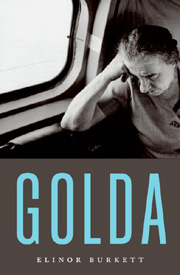
he has made out a good case for its full consideration. Narrow-minded evaluation of admired world figure Golda. By Elinor Burkett. New York: HarperCollins, 2008. 496 Pages. $27.95 Golda Meir was Israel's third prime minister, following David Ben-Gurion and Levi Eshkol. She was the first woman to become head of state in a Western country and she continues to be highly admired among American Jews. For Israelis, her reputation was somewhat tarnished by the country's performance in the Yom Kippur War when Israel suffered massive losses, having failed to heed warnings of imminent attacks by the Egyptians and the Syrians. Although she was personally exonerated, her Labor Party barely won the next election and she soon resigned. These dramatic events are detailed in this biography, which begins in the Pale of Settlement with the pogroms that led to massive emigration of Russian Jews, including Golda Meir's family. In Milwaukee where the family settled and in Denver where Golda spent a few months, she became deeply involved with Zionism and with Morris Meyerson, her future husband. She insisted that they settle in Palestine, which they did in 1921. They lived for a time on a kibbutz where Morris was very unhappy. As Golda became more and more involved in Zionist politics, they moved to Tel Aviv and, according to the biographer, Golda had several affairs. She helped to found the Mapai party and took on more and more responsibility. During the War of Independence, she raised vast sums of money from American Jews and was then appointed Israel's ambassador to the Soviet Union where thousands of Russian Jews were inspired by her. When it became apparent that there was little hope for friendship with the Soviets, Golda returned to Israel, first as minister of labor and then as foreign minister and, finally, as secretary-general of Mapai. In 1969, after Levi Eshkol died, Golda became prime minister, using her political skills to beat Moshe Dayan and Yigal Allon. In this book, the question is posed by the author, "had the country just inherited an aging political hack as its leader?" She is referred to as "imperious," "authoritarian," "overbearing," "intolerant," and "puritanical." "She ran roughshod over her ministers and unified the government in short order." Although she had difficulties at home with the trade unionists and with both secular and Orthodox Jews, her major concerns focused on relationships with the Arabs and with the Americans. A substantial part of the book describes Golda's interactions with Henry Kissinger and with King Hussein of Jordan, eventually leading to a detailed account of the Yom Kippur War. In summing up, author Burkett harshly criticizes Golda as "an intractable old lady" with "limited creativity" who "was as much poisoned by her environment as it was by her." In order to understand Burkett's negative appraisal, one has to examine her previous books in which she is equally disparaging of the Catholic church, the handling of AIDS, conservative women, treatment of childless Americans and American high schools. A journalist with a Ph.D. in history, Burkett uses a seemingly academic approach (this books has 67 pages of notes and bibliographical listings), to engage in jaundiced fault-finding. Oddly enough, despite her scholarly credentials, Burkett omits salient information such as the date of Golda Meir's birth, and when she writes that Golda died on December 8, there is no indication that the year was 1978. Indeed, throughout the book, dates are given without identifying the year, a peculiar and irritating habit. While this is a minor misdeed, it adds to the questions that readers will inevitably raise about Burkett's narrow-minded evaluation of a woman who deservedly ranks as a much admired world figure.
Short stories on Israeli-born daughter of American father, Israeli mother Ask for a Convertible. By Danit Brown. New York: Pantheon Books, 2008. 306 Pages. $22.95 This linked collection of short stories features Israeli-born Osnat Greenberg, daughter of an American father and an Israeli mother. We first meet her in 1984 when she is 12. She has just arrived in Ann Arbor, Mich., where her father, Marvin Greenberg, has accepted a position as a professor of mathematics. For the past 13 years, he has been living in Israel where he married Efrat, Osnat's mother. Supposedly, the move to America is temporary, but as the years go by, it is more and more apparent that Marvin has no intention of returning to Israel, much to Efrat's dismay. The first story recounts the difficulties Efrat and Osnat encounter as they make their initial adaptation to living in the United States. Efrat's problem is compounded when her mother dies and she returns to Israel for the funeral. She extends her stay to the point that Osnat makes her way to the airport in order to join her mother but is stopped at the ticket counter by a clerk who calls her father and he comes to pick her up. Eventually, Efrat returns to Ann Arbor. Intermingled with this experience is Osnat's association with her classmates, especially with Sanjay, an Indian boy who has been in the United States for three years. Mundane occurrences occupy the second story such as going to the dentist, tracking down another faculty member with the same name as Osnat's father, Marvin Greenberg, and meeting other Israelis. Throughout is the tension about when and whether the family will return to Israel. Inexplicably, the scene now shifts to a small town in Indiana where we meet two girls, Harriet and Jennifer. They are studying the story of Anne Frank in school. Harriet appears again after her parents are divorced and she attends college in southern Michigan. In another sudden change, we are introduced to Noam, a 28-year-old Israeli who goes to the United States so as to avoid reserve duty. To add to the confusion, Osnat crops up in 1995 when Rabin was assassinated. By then, she has graduated from college and is living in a Chicago suburb where she has one Christian boyfriend after another. Now, Osnat's path crosses Noam's when she goes to a restaurant where he is a waiter. They have a quick sexual encounter in her car. In a later story, their paths briefly cross again. Another rapid change of locale takes us to Wisconsin where Osnat is spending Christmas with one of her non-Jewish boyfriends. This one is serious because she has agreed to marry him, but this doesn't work out. Now, Harriet, at age 26, turns up as the bookkeeper in Fantasy Bridal, a shop that sells wedding packages with a theme where Efrat has been working for 10 years. She and Harriet establish a close relationship. For some inexplicable reason, the author switches to the first person so that this story is narrated by Efrat. By and large, the remaining four stories take place in Israel. The many variations in time, place, and cast of characters confuse the reader until it becomes clear that these stories are meant to stand on their own so that each one can be read independent of the others. This realization is difficult to come by since the people crisscross, appearing and re-appearing as they struggle to find their identity. Danit Brown holds a master's degree in fiction
and has published short stories in a number of literary magazines.
She is an assistant professor of English at Albion College, a small
liberal arts institution in Albion, Mich. This is Brown's first
book. It demonstrates considerable writing skill and holds out the
promise of better things to come. Dr. Morton I. Teicher is the Founding Dean, Wurzweiler School of Social Work, Yeshiva University and Dean Emeritus, School of Social Work, University of North Carolina at Chapel Hill. Updated 8/20/08
|
|
||||||